
Every parent wants the same thing—a place where their child feels safe, happy, loved, and encouraged to grow.
Yet with so many childcare centers available, choosing the right one can quickly become overwhelming.
One center may have beautiful classrooms.
Another may advertise experienced teachers.
A third might offer flexible schedules or educational programs.
So how do you know what truly matters?
The answer is simple: a great childcare center is about much more than its building or daily schedule. It is about the people, the environment, the values, and the experiences that help children develop confidence, curiosity, independence, and a lifelong love of learning.
The best childcare centers don’t simply care for children while parents are at work—they become trusted partners in a child’s early development.
In this guide, we’ll explore the qualities that separate an average childcare center from an exceptional one and help you understand what to look for before making one of the most important decisions for your family.
Why Quality Childcare Matters
The early years of a child’s life are filled with incredible growth.
Between infancy and age five, children develop the foundations for communication, emotional regulation, problem-solving, creativity, and social relationships.
These years shape how children learn, interact with others, and respond to new experiences throughout life.
Because of this, the childcare environment matters enormously.
A high-quality childcare center supports children in every area of development—not only academically, but emotionally, socially, and physically as well.
When children feel safe and valued, they become more willing to:
- Explore
- Ask questions
- Build friendships
- Solve problems
- Try new experiences
- Develop independence
Parents also benefit from knowing their child spends each day in an environment designed to help them thrive.
A Great Childcare Center Starts with Great People
Buildings don’t teach children.
People do.
The most beautiful classroom in the world cannot replace a caring, experienced educator who understands how children learn and grow.
That’s why one of the first things parents should evaluate isn’t the toys or decorations—it’s the people.
Ask yourself:
- Do teachers smile often?
- Do they get down to a child’s eye level?
- Do they speak calmly and respectfully?
- Do children seem comfortable approaching them?
- Are teachers actively involved in activities?
Children learn best when they feel emotionally secure.
Positive relationships with trusted adults build confidence, encourage curiosity, and help children feel comfortable exploring new challenges.
The strongest childcare programs invest in hiring educators who genuinely enjoy working with children—not simply supervising them.
1. A Safe and Secure Environment
Safety is the foundation of every great childcare center.
Parents should never have to wonder whether their child is protected throughout the day.
A professional childcare program should have clear safety procedures covering every part of the child’s experience.
Look for features such as:
- Secure entrances with controlled access
- Visitor check-in procedures
- Daily health and wellness checks
- Clean classrooms
- Childproof learning spaces
- Emergency evacuation plans
- CPR and First Aid trained staff
- Safe outdoor play areas
- Age-appropriate equipment
Safety also means emotional security.
Children should feel respected, supported, and encouraged—not frightened or intimidated.
When children feel emotionally safe, they become more willing to participate, ask questions, make friends, and develop confidence.
2. Experienced and Passionate Teachers
Teachers influence nearly every part of a child’s daycare experience.
An exceptional educator doesn’t simply supervise activities.
They:
- Encourage curiosity.
- Celebrate progress.
- Comfort children during difficult moments.
- Help children solve problems.
- Foster friendships.
- Inspire confidence.
Ask about the qualifications and experience of the teaching staff.
Important questions include:
- Do teachers receive ongoing professional development?
- Are they trained in early childhood education?
- Are they certified in CPR and First Aid?
- How long have they worked at the center?
Consistency is equally important.
When children see familiar teachers each day, they build trusting relationships that create emotional stability and confidence.
High staff turnover can make it more difficult for children to develop these important connections.
3. Learning Through Play
One of the biggest myths about childcare is that learning only happens when children sit quietly at a table.
In reality, children learn best by doing.
Play is how young children naturally explore the world around them.
Through play, children develop:
- Language skills
- Creativity
- Problem-solving
- Fine motor skills
- Gross motor skills
- Social skills
- Emotional regulation
A quality childcare center intentionally designs activities that make learning fun and meaningful.
Instead of memorizing information, children experiment, create, build, imagine, ask questions, and discover solutions on their own.
Whether children are building with blocks, painting, gardening, pretending in a dramatic play area, or exploring nature outside, every activity supports healthy development.
Learning through play doesn’t mean learning without purpose.
It means teaching in the way children learn best.
4. A Structured Yet Flexible Daily Routine
Children feel more confident when they know what to expect.
Predictable routines reduce anxiety while helping children develop healthy habits.
A balanced childcare schedule typically includes:
- Morning welcome
- Circle Time
- Educational activities
- Creative play
- Outdoor exploration
- Healthy meals
- Story time
- Rest time
- Music and movement
- Free choice learning
While routines provide structure, great childcare centers also remain flexible.
Teachers understand that infants, toddlers, and preschoolers have different developmental needs and adjust activities accordingly.
The goal isn’t to keep children busy every minute of the day.
The goal is to create meaningful experiences that balance learning, movement, rest, and play.
5. A Clean, Organized Learning Environment
Children are naturally curious.
They touch, explore, build, and investigate everything around them.
Because of this, cleanliness and organization are essential.
A high-quality childcare center maintains:
- Sanitized toys
- Organized classrooms
- Clearly defined learning areas
- Safe storage for supplies
- Child-sized furniture
- Bright, welcoming spaces
An organized classroom also supports independence.
When children know where materials belong, they begin taking responsibility for cleaning up, making choices, and caring for their environment.
A well-designed classroom encourages learning without overwhelming children with unnecessary distractions.
6. Strong Communication with Families
One of the most important characteristics of a great childcare center is open, honest, and consistent communication with parents.
Families should never feel disconnected from their child’s day.
Instead, they should feel like active partners in their child’s learning journey.
Effective communication builds trust and creates a stronger connection between home and the classroom.
A quality childcare center should keep parents informed through:
- Daily reports
- Photos and videos
- Parent-teacher conferences
- Progress updates
- Monthly newsletters
- Classroom announcements
- Phone calls when needed
Parents should also feel comfortable asking questions or discussing concerns at any time.
Great communication isn’t only about sharing information.
It’s about building relationships.
When teachers and families work together, children receive consistent support both at home and at school.
7. Healthy Meals That Support Growing Minds and Bodies
Nutrition plays a vital role in early childhood development.
Young children need balanced meals to fuel learning, support healthy growth, and maintain energy throughout the day.
A high-quality childcare center understands that mealtime is about more than nutrition.
It’s also an opportunity to teach valuable life skills.
Children learn how to:
- Practice good table manners
- Serve themselves when appropriate
- Try new foods
- Communicate with others
- Build independence
- Develop healthy eating habits
Ask questions such as:
- Are meals freshly prepared?
- Are healthy snacks provided?
- How are allergies managed?
- Can special dietary needs be accommodated?
- Is water available throughout the day?
Healthy eating habits developed during early childhood often continue throughout life.
8. Outdoor Play Is an Essential Part of Learning
Children aren’t meant to spend the entire day indoors.
Outdoor experiences provide opportunities that simply can’t be replicated inside a classroom.
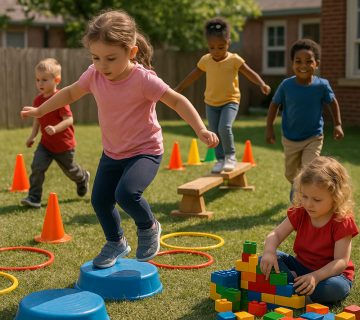
Running, climbing, balancing, exploring nature, and playing with friends all contribute to healthy physical and emotional development.
Daily outdoor play helps children improve:
- Gross motor skills
- Coordination
- Balance
- Confidence
- Teamwork
- Creativity
- Problem-solving
Nature also encourages curiosity.
Whether children are watching butterflies, collecting leaves, planting flowers, or blowing bubbles, every outdoor experience becomes another opportunity to learn.
A quality childcare center values outdoor learning as much as classroom learning.
9. Social and Emotional Development Comes First
Parents often focus on letters, numbers, and school readiness.
While academic skills are important, social and emotional development is equally valuable.
Children first need to learn how to:
- Share
- Take turns
- Express emotions
- Solve conflicts
- Build friendships
- Show empathy
- Develop confidence
These life skills influence future success both inside and outside the classroom.
Experienced educators help children navigate emotions with patience and encouragement rather than punishment.
Every interaction becomes an opportunity to teach kindness, respect, and resilience.
10. Small Class Sizes Mean More Individual Attention
Every child learns differently.
Some children enjoy group activities immediately.
Others need extra encouragement before joining.
Smaller class sizes allow teachers to recognize these individual differences and respond accordingly.
With fewer children in each classroom, educators can:
- Build stronger relationships
- Observe developmental milestones
- Adapt activities to individual needs
- Provide additional encouragement
- Support children at their own pace
Rather than feeling overlooked, children receive the attention they need to grow with confidence.
Parents should always ask about teacher-to-child ratios when comparing childcare centers.
11. Every Child Should Feel Welcome
Great childcare centers celebrate the uniqueness of every child.
Children come from different cultures, backgrounds, family structures, and learning styles.
An inclusive learning environment helps every child feel respected, valued, and accepted.
Inclusive childcare means:
- Respecting diversity
- Encouraging kindness
- Supporting different learning styles
- Celebrating cultural traditions
- Creating opportunities for every child to participate
When children grow up in an inclusive environment, they develop empathy, respect, and appreciation for others.
These values stay with them throughout life.
12. Parent Partnerships Create Better Outcomes
Parents know their children better than anyone else.
Teachers observe children in a unique learning environment every day.
When these two perspectives come together, children benefit tremendously.
A strong childcare center encourages parents to become active partners by:
- Sharing developmental goals
- Attending conferences
- Participating in family events
- Communicating openly
- Celebrating milestones together
Children feel more secure when they see consistency between home and daycare.
Partnership creates trust—and trust creates confidence.
13. Continuous Improvement Matters
The best childcare centers never stop learning.
Just as children continue developing, great educators continue improving.
Ask whether the center invests in:
- Staff training
- Professional development
- Updated learning materials
- Safety improvements
- Curriculum enhancements
- Family feedback
Centers committed to continuous improvement consistently look for ways to provide an even better experience for children and families.
Growth shouldn’t only apply to children.
It should apply to the entire childcare community.
Common Mistakes Parents Make When Choosing a Childcare Center
Finding the right childcare center isn’t always easy.
Sometimes parents unintentionally focus on the wrong details.
Here are some common mistakes to avoid:
Choosing based only on price
Affordable childcare is important, but quality, safety, and teacher experience should always be part of the decision.
Focusing only on the building
Beautiful classrooms are wonderful—but caring teachers matter much more.
Relationships shape children’s experiences far more than decorations.
Not Asking Enough Questions
Many parents feel uncomfortable asking detailed questions during a tour.
Remember:
You’re trusting someone with your child.
There are no “too many questions.”
Comparing Every Child
Every child develops differently.
Avoid comparing your child’s adjustment or development to siblings or friends.
Instead, choose a program that supports your child’s individual needs.
Ignoring Your Instincts
Sometimes everything looks perfect on paper, yet something still feels off.
Trust your instincts.
If you don’t feel comfortable during your visit, continue your search.
The right childcare center should give you confidence—not uncertainty
Why Families Choose Twinkle Child Care
At Twinkle Child Care, we believe that every child deserves a place where they feel safe, valued, and inspired to learn.
We understand that choosing a childcare center is one of the most important decisions a family can make. That’s why we’ve created an environment where children can explore, build confidence, and develop essential life skills through meaningful everyday experiences.
Our educators are passionate about early childhood education and believe that learning should be joyful, engaging, and age-appropriate. Every activity is thoughtfully planned to encourage curiosity, creativity, and independence while supporting each child’s unique developmental journey.
Families choose Twinkle because we offer:
- Safe and secure classrooms
- Experienced and caring educators
- Learning through play
- Healthy meals and snacks
- Daily outdoor exploration
- Age-appropriate learning experiences
- Open communication with families
- Flexible childcare programs
- A warm and welcoming community
Our mission is simple:
To help every child learn, play, grow, and thrive in an environment filled with kindness, encouragement, and opportunity.
Questions to Ask During Your Childcare Tour
Before making your final decision, bring a checklist with you.
Here are a few essential questions:
- How do teachers communicate with parents?
- What does a typical day look like?
- How are conflicts between children handled?
- What safety procedures are in place?
- How often do children play outside?
- What curriculum do you follow?
- How do you support children emotionally?
- How are meals and allergies managed?
- What are your teacher-to-child ratios?
- How do you help children prepare for kindergarten?
The answers to these questions will help you understand whether the childcare center aligns with your family’s values and your child’s needs.
Final Thoughts
The best childcare center is not necessarily the newest building or the one with the most expensive equipment.
It’s the place where children feel safe enough to explore, confident enough to ask questions, and supported enough to become the best version of themselves.
Great childcare is built on relationships, trust, meaningful learning experiences, and a genuine commitment to every child’s growth.
As you compare childcare options, remember that your decision isn’t only about today.
It’s about creating a strong foundation for your child’s future.
Take your time.
Visit several childcare centers.
Observe carefully.
Ask questions.
Trust your instincts.
When you find a place where your child is excited to learn and you feel complete peace of mind, you’ll know you’ve found the right childcare center.
Frequently Asked Questions
What is the most important thing to look for in a childcare center?
Safety, experienced educators, positive teacher-child relationships, clean learning environments, and a curriculum that supports social, emotional, and cognitive development are all essential qualities of a high-quality childcare center.
How do I know if a childcare center is high quality?
Look for engaged teachers, happy children, strong communication with parents, age-appropriate activities, low teacher-to-child ratios, and a safe, welcoming environment.
Should I choose a childcare center close to home or work?
Both options have benefits. Consider your daily routine, commute, emergency contacts, and where your child will spend the most consistent time. Convenience is important, but the quality of care should always come first.
Why is learning through play important?
Children naturally learn through exploration, creativity, and hands-on experiences. Play helps develop language, problem-solving, motor skills, confidence, and social-emotional abilities while making learning enjoyable.
What should I observe during a childcare tour?
Watch how teachers interact with children, whether children appear happy and engaged, how clean the classrooms are, and how the daily routine is organized. The atmosphere often tells you as much as the answers to your questions.
How does a childcare center prepare children for school?
Quality childcare programs build early literacy, communication, independence, emotional regulation, and social skills through structured routines and play-based learning—creating a strong foundation for kindergarten and beyond.
Ready to Find the Right Childcare Center?
Choosing childcare is about more than finding a place for your child during the day—it’s about finding a community where they can grow with confidence.
At Twinkle Child Care, we’re committed to creating a safe, nurturing, and engaging environment where every child feels supported and every family feels welcome.
We invite you to schedule a tour, meet our educators, explore our classrooms, and experience what makes Twinkle a trusted choice for families.
Contact us today to learn more about our programs and enrollment opportunities.



No comment